RXBio Translates Sequence to Science and Industry

 中文
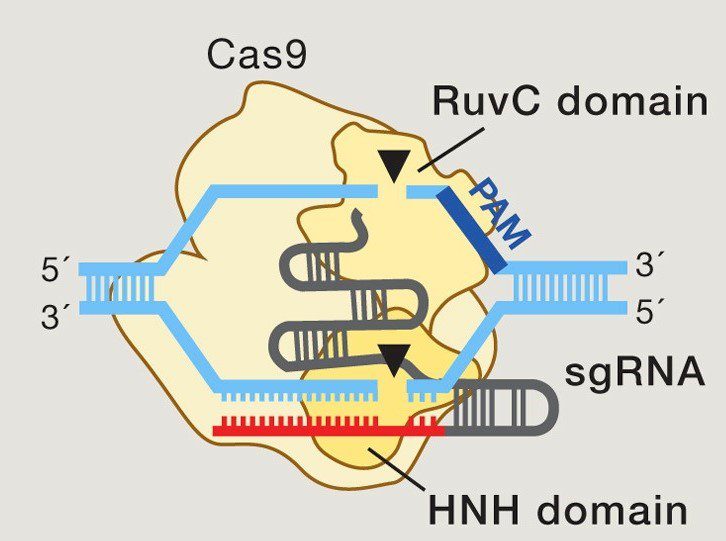
中文CRISPR/Cas9 is a powerful tool for gene editing. For gene knockout, a guide RNA (guide RNA 1, guide RNA 2) is designed respectively upstream and downstream of the target gene, and then they are transferred into cells together with the plasmid containing the Cas9 protein-encoding gene. The guide RNA can target the target sequence near the PAM (Protospacer Adjacent Motif) through base complementary pairing, and the Cas9 protein will cause double-strand breaks in the DNA upstream and downstream of the gene. And there is a response mechanism for DNA damage repair in organisms themselves, which will connect the sequences at both ends of the break, thus achieving the precise knockout of the target gene in cells. There is a relatively conserved PAM sequence (NGG) near the region of the target gene to be edited, and the guide RNA needs to be base complementary paired with the sequence upstream of the PAM (Chakrabarti, Henser-Brownhill et al. 2019).
Using CRISPR/Cas9 to construct knockout cell lines, in these cell lines, the target gene can be precisely deleted, completely removing the protein encoded by it.
✔ CRISPR/Cas9 improves the accuracy and specificity of gene knockout.
✔ It is applicable to knocking out non-coding RNAs with fragments longer than 3000 nucleotides.
✔ Construct stable transfected cell lines with knocked-out genes, which can be subsequently used for in vivo animal experiments, cell phenotypic experiment detection and so on.