
RXBio Translates Sequence to Science and Industry

 中文
中文The surface of normal cells is composed of lipids that are asymmetrically distributed on the inner and outer leaflets of the plasma membrane. One of these lipids, phosphatidylserine (PS), is usually only distributed on the inner leaflet of the plasma membrane and thus is only exposed to the cytoplasm. However, during the process of apoptosis, lipid asymmetry disappears. Meanwhile, PS is exposed on the outer leaflet of the plasma membrane. Annexin V, a 36-kDa calcium-dependent phospholipid-binding protein, is capable of binding to PS. Therefore, fluorescently labeled Annexin V can be used to detect PS exposed on the outside of apoptotic cells. Annexin V can also stain necrotic cells because the membranes of these cells are ruptured, allowing Annexin V to access the entire plasma membrane. However, Annexin V cannot distinguish between necrotic cells (late apoptotic cells) and early apoptotic cells. Therefore, by co-staining with propidium iodide (PI), apoptotic cells can be distinguished from necrotic cells (late apoptotic cells), as the cell membranes of early apoptotic cells and living cells remain intact. PI can enter necrotic cells (late apoptotic cells) but is excluded by early apoptotic cells. Thus, apoptosis and necrosis of cells can be quantified by Annexin V binding and PI uptake followed by flow cytometry detection.
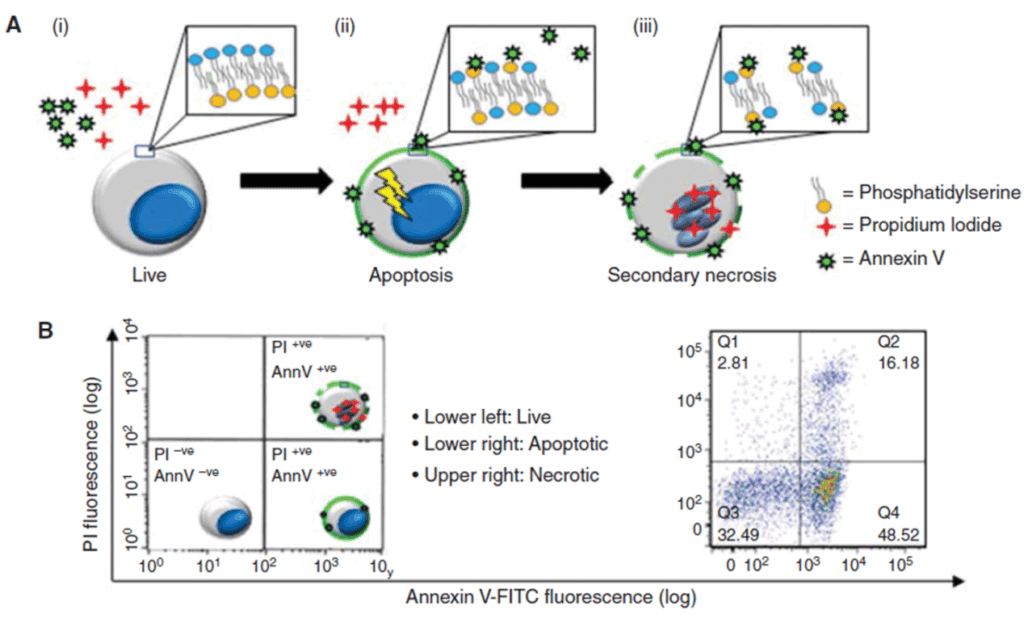
This figure is a schematic diagram for measuring cell apoptosis by Annexin V binding and PI uptake.
(A) It describes the Annexin V binding and PI uptake in apoptotic cells.
(i) Phosphatidylserine (PS) is located on the inner leaflet of the intact plasma membrane of living cells, and these cells will not be stained by Annexin V and PI.
(ii) PS flips to the outer leaflet of the plasma membrane of apoptotic cells. These cells bind Annexin V on the outside but still are not stained by PI.
(iii) The membranes of secondary necrotic cells (late apoptotic cells) are ruptured. Annexin V binds to PS on the plasma membrane, and PI is absorbed and binds to DNA.
(B) The left picture is an example of a dot plot of flow cytometry data, and the right picture is an actual case. Among them, the Q1 population is the necrotic cell population (Annexin V negative, PI positive), the Q2 population is the late apoptotic cell population (Annexin V positive, PI positive), the Q3 population is the living cell population (Annexin V negative, PI negative), and the Q4 population is the early apoptotic cell population (Annexin V positive, PI negative).
✔ Strict controls and experimental quality control points to ensure the accuracy and reliability of the results.
✔ Data analysis, graphing and English materials and methods, along with detailed raw data, will safeguard the authenticity of your data and facilitate your article publication.
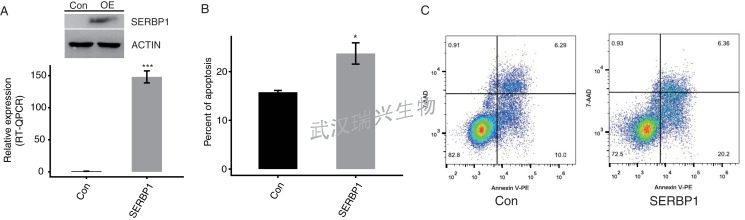
✔ Published article cases.
Delivery Contents:
A. Raw data of all experimental results.
B. Experimental reports (including detailed experimental procedures and the manufacturer and catalog number information of the main instruments and reagents).
C. English materials and methods.